|
Carthaginians and Romans:
In ancient timesTunisia was part of the mighty Carthaginian Empire.Its chief city, Carthage,
was reputedly founded in 814BC by Phoenician traders, who had previously established several
small trading posts along the North African coast. The site of Carthage which became the
largest and most famous of these Phoenician settlements, is thought to have been slightly to
the north-east of the modern city of Tunis.
The Carthaginian Empire dominated most of North Africa, as well as parts of the Iberian
Peninsula , Sardinia and Sicily . By the third century BC , however, trouble was brewing for
the Carthaginians, in the shape of the fast-expanding Roman Empire.
Although Rome had signed several treaties with Carthage and recognised its power , the Roman
leaders watched closely for an opportunity to overthrow it. War clouds gathered and three
bloody struggles -- the Punic Wars -- were fought. In the third and last of these, which took
place in 149-146BC , the Carthaginians were completely defeated and the city of Carthage -
destroyed by Scipio's army.
Carthaginian territory, roughly corresponding to modern Tunisia, was made a Roman province
known as "Africa Vetus" . As a province of Rome , the land was intensively cultivated and
provided the Romans with wood , wool, olive oil and wheat . The region's prosperity grew ,
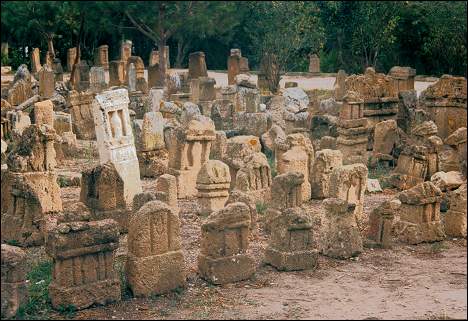
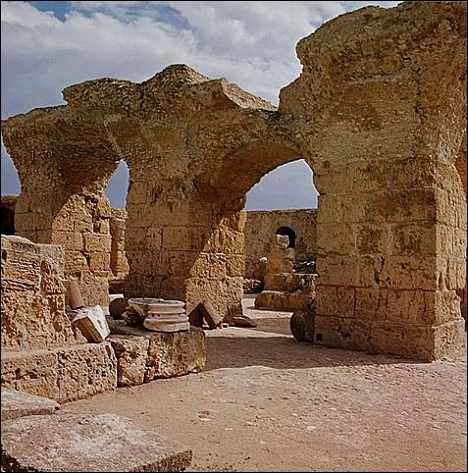
and a large number of cities spread across the province . Many archaeological sites today
bear witness to the splendour of both pre-Roman and Roman Carthage.
|
|
|
The Vandals and Islam :
By the 5th century AD, the power of Rome was weakening and the province known as Africa fell
to a Teutonic tribe, the Vandals, in about AD430. The Vandals ruled for a century before Rome,
under Belisarius, re-captured it in about AD534.
Arab invaders conquered the region in the 7th century AD, and the former Romano-Christian
culture was replaced by Islam.
The land was now known as Ifriqiya, and power was wielded by a succession of ruling dynasties,
including the Aghlabites, the Fatimids and, by the 10th century, the Zeirids. The capital was
moved from Carthage to al- Kairouan . Later invasions were made by the Sicilian Normans under
Roger II in the 12th century and by the Spanish in the first half of the 16th century.
|
|
Turkish rule and piracy :
In 1574, Ottoman armies defeated the Spanish , and Tunisia became part of the Ottoman Empire.
A period of peace and stability followed , with Turkish imperial rule effected through local
governors , known first as deys and later as beys . The first of these, al- Husayn ibn Ali
(ruled 1705-1740) founded the Husaynid dynasty and established considerable prosperity in the
region.
Much of this prosperity was founded on piracy. This had been an important Tunisian enterprise
for several centuries , with Tunisia receiving 'protection money' in the form of bribes from
a large number of sea-going nations.
The Barbary Coast of North Africa harboured several corsair bases , all of which flourished
during the late 17th and early 18th centuries. The end came in 1815, when the US Navy attacked
Tunis and put an end to its piratical source of revenue.
French colonisation :
The demise of piracy and the resulting loss of revenue plunged the region into economic chaos.
France, Italy and Great Britain all sought to realise their imperialistic ambitions in Tunisia
and in 1881, France wielded the upper hand in the signing of the Bardo Treaty Treaty of Kasser-
Said), which acknowledged Tunisia as a French protectorate.
During the late 1880s a group of French settlers colonised the region along the northern coast.
They began opening businesses and exerted a strong Western influence on the hitherto Arab culture.
Although the bey was still Tunisia's nominal ruler, the country was effectively governed by a
French resident general. Despite some unrest by local patriotic movements, Tunisia remained a
French protectorate until 1956.
During the Second World War, Tunisia supported the Vichy government which ruled France after its
capitulation to the Nazis in 1940 . Allied forces landed in Algeria and Morocco and there was
fierce fighting between the Allies and the German forces , resulting in Germany's capitulation
in north Africa in 1943. Control of Tunisia was immediately handed over to the Free French and
the reigning bey was arrested as a German collaborator. This exacerbated bad feeling against
the French authorities and eventually resulted in a renewal of nationalist unrest.
Violent resistance to French rule boiled up in 1954 . The French premier, Pierre Mendes-France
arrived in July of that year to attempt conciliation and , after lengthy negotiations , France
promised the protectorate full internal autonomy under a Tunisian government
France was to retain control of foreign policy and defence, however.
This proposition proved acceptable to the nationalist leaders and the first all-Tunisian
government was set up in September 1954. Not all nationalists were content with the new regime,
however, and pressed for even greater independence. In March 1956, a treaty was signed in Paris
invalidating the Bardo Treaty of 1881, and recognising Tunisia as a sovereign state, ruled as a
constitutional monarchy under the bey.
French withdrawal and national autonomy :
The first Tunisian elections took place in April 1956 and the Tunisian statesman Habib Bourguiba
was elected President of the first National Assembly. Bourguiba had previously been head of the
national liberation movement, Neo-Destour. Tunisia became a member of the United Nations in
November 1956.
During the following year, the bey was finally overthrown and Tunisia was proclaimed a republic,
with Bourguiba elected President . Many French residents departed in haste , fearing local
reprisals, and relations with France deteriorated still further in 1957 with clashes between
Tunisian and French troops along the Algerian border . The 1958 bombing of the Tunisian village
of Sakiet-Sidi-Youssef by French military planes killed 68 Tunisians and wounded a further
100. The French government stated that this attack had been retaliatory action for Tunisian
support of Algeria over independence.
Tunisia demanded the French evacuation of a naval base at Bizerte, and Tunisian troops held the
base under siege in July 1961 . A UN cease-fire was demanded , and France was asked by the UN
General Assembly to withdraw from Bizerte . After lengthy discussion , France did withdraw in
October 1963.
Political change :
Tunisia strengthened its ties with the Arab world during the mid-sixties , and relations with
both Algeria and Morocco improved dramatically. France, meanwhile had withdrawn all financial
aid from Tunisia, resulting in serious economic problems.
In 1964, the former Neo-Destour Party became known as the Parti Socialiste Destourien (Destourian-
Socialist Party) and President Bourguiba was re-elected by a huge majority
Although strong links were being forged with Saudi Arabia at this time, relations with other Arab
countries, particularly Egypt, began to decline, resulting in Tunisia's eventual boycott of Arab
League meetings.
Bourguiba's third term of office began in November 1969, and in March 1975 he was proclaimed
"President for life", in recognition of his services to the country.
but in 1987, zine el-Abidine ben Ali, be the new president for tunisia .
|
|
|